UDC 004.8
DEVELOPING A RECOMMENDATION SYSTEM USING NEURAL NETWORKS
Abstract. This article explores the use of neural networks to improve recommendation systems in the entertainment event industry. As user preferences become more complex, traditional methods like collaborative and content-based filtering are no longer sufficient. Neural networks offer a promising solution by detecting complex patterns and providing personalized recommendations. The study discusses current technologies, their limitations, and proposes strategies to improve the accuracy, adaptability, and efficiency of recommendation models in real-world scenarios.
Keywords: neural networks, recommendation systems, entertainment events, personalization, machine learning, deep learning, event recommendation
Introduction
In recent years, recommendation systems have become integral to many digital platforms, helping users navigate the overwhelming amount of available content. From e-commerce to online streaming, these systems enhance user satisfaction by suggesting relevant items based on individual preferences.
One growing area of application is the recommendation of entertainment events in urban environments. With a constant flow of concerts, theater performances, exhibitions, and festivals, users often struggle to discover events that match their interests, location, and schedule. Traditional recommendation techniques—such as collaborative filtering and content-based filtering—have been widely used in these scenarios. However, they face significant limitations, including the cold-start problem, data sparsity, and an inability to capture complex, dynamic user preferences.
To overcome these challenges, the integration of neural networks into recommendation systems has emerged as a promising direction. Neural networks, particularly deep learning models, offer powerful tools for modeling non-linear patterns, learning high-dimensional representations, and adapting to real-time data. These capabilities make them well-suited for building advanced, personalized, and context-aware event recommendation systems.
This article presents a conceptual approach to developing a neural network-based recommendation system tailored to urban entertainment events. The proposed system aims to improve accuracy, personalization, and responsiveness by leveraging neural architectures capable of processing diverse data sources.
Event recommendation systems for urban entertainment
In today’s hyper-connected and culturally vibrant urban landscapes, individuals are constantly exposed to a wide array of entertainment options, ranging from music concerts and theater performances to art exhibitions, film festivals, and local community events. The sheer volume and diversity of available events can often overwhelm users, making it increasingly difficult to identify activities that match their personal interests, schedules, and proximity.
The primary goal of an event recommendation system is to simplify the discovery process by providing curated suggestions that resonate with a user’s past preferences, current context, and potential interests [1]. These systems aim to reduce the information overload that users face when browsing event listings, allowing them to make quicker and more satisfying decisions. In the context of urban entertainment, the success of such a system depends not only on its technical accuracy but also on its ability to capture the spontaneity, diversity, and temporality of real-world events.
Urban entertainment recommendation systems operate in a domain characterized by several distinct features that influence the design and effectiveness of algorithms. One of the most critical characteristics is temporal sensitivity. Unlike traditional product recommendations, which can remain valid over extended periods, urban events are inherently time-bound. An event that is relevant today may be irrelevant tomorrow.
Another essential factor is geographic specificity. Events take place at physical venues, and user location plays a central role in determining whether a recommendation is useful. A highly-rated concert may be of little value to a user if it occurs on the other side of the city or in a different town. Therefore, location-awareness must be an integral part of any effective urban entertainment recommender, incorporating data such as GPS coordinates, transportation availability, and user mobility patterns.
To address these challenges, modern recommendation systems are increasingly turning toward machine learning and, more specifically, neural networks, which offer enhanced flexibility and performance. By learning complex patterns and high-dimensional relationships in user and event data, neural network models provide a foundation for developing systems that can make real-time, personalized, and context-aware event suggestions. These models open the door to a new generation of urban entertainment platforms that not only understand what the user likes but also anticipate when and where an event will be most appealing.
Neural networks in recommendation systems
The ability of neural networks — especially deep learning models — to uncover intricate patterns in user behavior and item characteristics has made them a preferred choice for building next-generation recommender systems. Unlike traditional algorithms, which rely on predefined similarity measures or fixed rule-based logic, neural networks learn to represent users and items in a shared latent space, enabling more nuanced and context-aware recommendations.
One of the most compelling advantages of neural networks is their capacity to extract nonlinear and high-order relationships from heterogeneous data sources. In the domain of event recommendation, this capability is particularly valuable because users’ preferences often evolve over time, depend on situational factors, and involve subtle cues that go beyond simple event attributes.
Neural networks also support the integration of multiple modalities of data. A single recommendation model can incorporate textual information from event descriptions, visual content such as promotional posters, and behavioral data including browsing history and ticket purchases. This multimodal learning process enables systems to form a holistic view of both user preferences and item characteristics, which is crucial in entertainment-focused applications where aesthetic and emotional appeal often influence decision-making.
Deep learning approaches to recommendation
A variety of deep learning architectures have been adopted to tackle the diverse challenges of recommendation systems. Each of these architectures brings specific strengths that address particular aspects of the recommendation task, especially in entertainment domains.
One of the foundational models in neural recommendation systems is the autoencoder. Autoencoders are neural networks trained to reproduce their input data by encoding it into a compressed representation and then decoding it back to the original form. In recommender systems, autoencoders are commonly used for dimensionality reduction and feature learning. They can generate compact embeddings of user preferences or event attributes, which can then be used to compute similarity scores or serve as input to more complex models. These embeddings help mitigate sparsity in user-item interaction matrices and enable better generalization.
Another architecture that plays a crucial role is the Recurrent Neural Network (RNN). Designed to handle sequential data, RNNs are particularly well-suited for modeling the temporal dynamics of user interactions. In the context of event recommendations, an RNN can learn to anticipate future interests based on a user’s chronological activity, such as past event attendance, browsing behavior, or social media engagement. This temporal sensitivity allows the system to capture short-term trends and adapt recommendations as the user’s preferences evolve [2].
For multimedia-based recommendations, Convolutional Neural Networks (CNNs) have become increasingly relevant. CNNs are adept at extracting features from visual content, making them ideal for analyzing images associated with events, such as posters, venue photos, or video trailers. These visual cues often contain important information about the genre, tone, or popularity of an event. By incorporating CNN-derived features into the recommendation process, systems can enhance their understanding of what attracts users visually, leading to more engaging suggestions.
As recommendation systems grow more sophisticated, deep hybrid models have emerged as a powerful solution for combining the strengths of multiple approaches. These models integrate collaborative filtering with content-based filtering within a unified neural architecture. For instance, a hybrid model might use collaborative embeddings to capture user-item interaction patterns while simultaneously processing event metadata through fully connected layers. This dual-input structure allows the model to benefit from both user history and event content, resulting in robust and scalable recommendations that adapt well to both cold-start and dynamic scenarios.
Real-time adaptation and continuous learning
One of the key requirements for event recommendation systems is their ability to respond in real time to new data and changing conditions. Neural networks support this through continuous learning frameworks that can be retrained or fine-tuned incrementally. As new events are added to the system or users interact with content, the model can update its parameters to reflect the latest information. This adaptability ensures that the recommendations remain relevant and timely, a crucial factor in urban entertainment environments where events are transient and user engagement is fleeting.
Moreover, neural networks facilitate the use of context-aware recommendation, where variables such as time of day, weather, social context, or emotional state are incorporated into the model. For example, a user might be more interested in indoor events during rainy days or might prefer upbeat events after a stressful workweek. By embedding contextual signals into the recommendation pipeline, neural networks enable a more personalized and responsive user experience.
In conclusion, the application of neural networks to recommendation systems represents a major advancement in personalization technology. These models offer a flexible, scalable, and intelligent way to understand complex user behaviors and deliver contextually relevant suggestions. In the specific context of urban event recommendation, where content is diverse, user interests are dynamic, and timing is critical, neural networks offer a uniquely powerful toolkit for creating systems that are both accurate and engaging [3].
Recommendation system concept
The conceptual architecture of a neural network-based event recommendation system is composed of several tightly integrated modules. Each of them plays a crucial role in delivering personalized, timely, and context-aware recommendations to users. Together, they form a dynamic ecosystem capable of learning and evolving based on user behavior and feedback. Let's consider the conceptual structure of the recommendation system (Figure 1).
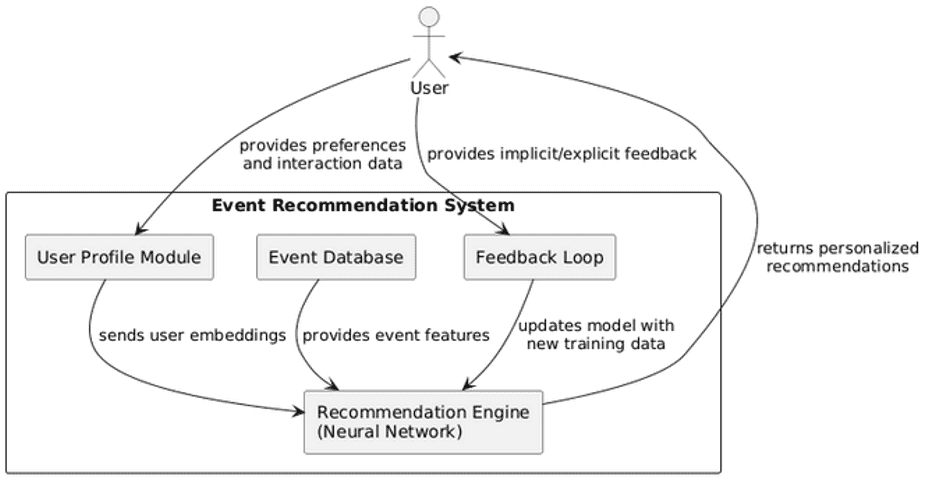
At the core of the system lies the Recommendation Engine, powered by a neural network model that processes user data and event information to generate personalized suggestions. This engine is supported by auxiliary modules responsible for user data acquisition, content storage, and continuous improvement through feedback.
User Profile Module is responsible for constructing and maintaining a comprehensive digital representation of each user. It gathers data from multiple sources, including registration forms, explicit preference selections, browsing history, social interactions, and past event attendance. Over time, this module dynamically updates the user profile to reflect changing interests and behavior patterns. By feeding high-quality user embeddings into the neural network, it ensures that the recommendations remain relevant and personalized.
The Event Database acts as the central repository of all event-related information. It includes structured metadata such as event title, date, time, location, category (e.g., music, art, tech), and descriptive content like images, tags, videos, or user reviews. In addition to being a source of content for recommendations, the database can also support filtering based on user-defined criteria (e.g., distance from current location, event cost, or availability). This module enables the system to consider both static and dynamic event properties during recommendation.
Recommendation Engine (Neural Network) is the intelligent core of the system that performs the actual matching between user interests and available events. It utilizes neural network architectures such as autoencoders, recurrent neural networks (RNNs), or hybrid models that combine collaborative and content-based filtering. The engine learns to encode both users and events into a shared latent space, where it can evaluate their compatibility using learned similarity metrics. By continuously retraining on updated user behavior and feedback, the engine evolves to provide increasingly accurate suggestions.
The Feedback Loop captures user responses to recommended events—whether they clicked, saved, attended, ignored, or rated the event—and transforms this feedback into training data for the model. This module is responsible for closing the learning cycle, enabling the system to adapt in real-time and improve over time. It also helps address the cold-start problem by gathering implicit feedback from new users or newly listed events.
When recommendations are requested, the Recommendation Engine receives both user embeddings and event data from the Event Database, computes relevance scores, and returns a curated list of events. After the user interacts with the recommendations, the Feedback Loop captures the results and adjusts the model accordingly.
Conclusion
The integration of neural networks into event recommendation systems presents a transformative step forward in enhancing personalization, adaptability, and real-time responsiveness. As urban environments become increasingly saturated with diverse and rapidly changing entertainment offerings, traditional filtering methods alone struggle to meet the demands of users seeking relevant, engaging experiences.
Neural network-based models—through their ability to learn from complex, multimodal data and capture evolving user preferences—offer a more nuanced and scalable solution. Whether through autoencoders for feature extraction, RNNs for temporal modeling, or CNNs for analyzing visual content, these architectures enable systems to deliver recommendations that are context-aware, visually informed, and behaviorally aligned with user needs.
Ultimately, the proposed conceptual framework highlights how neural networks can power the next generation of recommendation systems, offering more intuitive and satisfying user experiences while addressing longstanding challenges in the field. Future work may explore further enhancements through reinforcement learning, emotion-aware systems, or cross-platform integration to deepen the personalization and reach of event discovery platforms.
References
- Зайцева С.А. Ценностные регулятивы «рекомендательной системы» в контексте распространения нейросетевых моделей / С.А. Зайцева, В.А. Смирнов // Вестник Ивановского государственного университета. – 2022. – № 1. – С. 152-160.
- Садовская А.В. Повышение разнообразия рекомендаций за счет персонализации / А.В. Садовская, А.Г. Афанасьев, Г.И. Афанасьев // E-Scio. – 2023. – № 8 (83) – С. 141-160.
- Сапрыкин Д.А. Возможности применения машинного обучения в мобильных приложениях для персонализированной рекомендации контента / Д.А. Сапрыкин, К.В. Подольский, А.В. Панов // Международный журнал гуманитарных и естественных наук – 2023. – № 12 (87) – С. 80-83.