UDC 004.89
Abstract. The development of intelligent teaching assistants has gained attention due to their potential to enhance learning and improve educator efficiency. This paper explores the design of an intelligent teaching assistant based on a knowledge graph, which represents relationships between concepts. The assistant can answer questions, explain material and support teachers in managing student queries. An example of a knowledge graph for a computer science course has been provided. It has also been demonstrated how the assistant answers queries and discussed the integration of natural language processing (NLP) for better interaction and accuracy.
Keywords: intelligent teaching assistant, knowledge graph, natural language processing, educational technology, question answering, teacher support, course content, concept relationships, NLP techniques, student queries, graph-based learning, computer science education.
Introduction
The concept of intelligent teaching assistants has emerged as a response to the increasing need for personalized and scalable educational support. Traditional classroom settings often face challenges in addressing individual student needs, especially in large classes where teachers are unable to provide one-on-one assistance to each student. With advancements in artificial intelligence (AI) and natural language processing (NLP), it is now possible to create digital assistants that can assist teachers and students in answering questions, explaining content, and guiding students through the learning process.
One of the most effective ways to model and organize educational content is through the use of a knowledge graph [1]. A knowledge graph is a network of concepts or entities linked together by relationships, making it possible to visualize and access information more efficiently. Knowledge graphs have been used in various fields, including search engines, healthcare, and e-commerce, and their application in education is a promising area of research.
This paper presents the development of an intelligent teaching assistant based on a knowledge graph. We explore the design and architecture of such an assistant, the creation of a knowledge graph, and the query-answering capabilities it offers. The goal is to demonstrate how knowledge graphs can be used to enhance the interaction between students and teachers, streamline the process of answering questions, and provide accurate explanations of theoretical material.
Knowledge Graph for Educational Content
A knowledge graph is a data structure used to represent knowledge through entities (or nodes) and relationships (or edges). It is particularly powerful in representing interconnected information, making it an ideal solution for organizing educational content. In the context of an educational course, a knowledge graph can be used to visually and structurally map the relationships between different concepts, terms, and topics. This structure allows for easy navigation, query answering, and comprehension of how different topics are interrelated. The connections between concepts can be classified using different types of relationships such as "is a type of," "depends on," "includes," "is related to," "is a part of," etc.
In educational settings, especially in fields like computer science, mathematics, or physics, topics often build upon one another. This hierarchical and interdependent nature makes knowledge graphs highly valuable for both students and educators. The graph not only helps visualize the content but also provides a basis for answering questions, elaborating on concepts, and even discovering new information that wasn't previously explored.
Structure of a Knowledge Graph
A knowledge graph can be divided into two core components:
These edges help to form the network of connections between various concepts [2]. Such networks are particularly valuable because they allow a teaching assistant based on this structure to answer questions that require an understanding of multiple concepts in relation to one another.
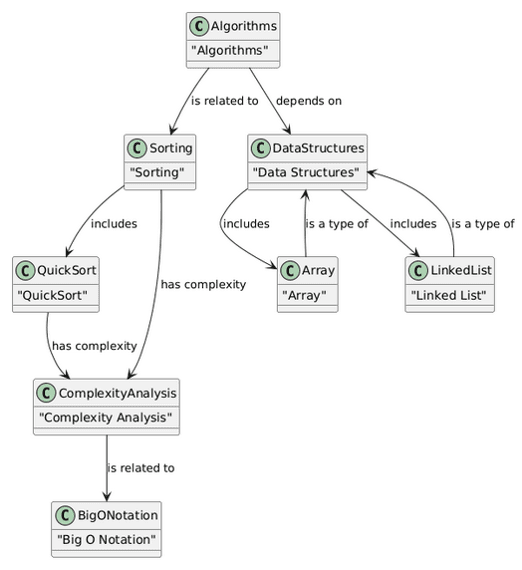
Example of a Knowledge Graph for Computer Science
To illustrate how knowledge graphs are applied in the context of education, let’s consider a portion of a knowledge graph for a computer science course. In this graph, we’ll model several key concepts from the subject of algorithms (Figure 1).
This knowledge graph can be broken down as follows:
Relationships in a Knowledge Graph
The relationships in a knowledge graph can serve various purposes, such as:
Natural Language Processing (NLP)
When a student submits a query, the first task of the assistant is to process the question and extract the relevant information. This process is done through Natural Language Processing (NLP), a subfield of artificial intelligence focused on enabling machines to understand, interpret, and generate human language [3]. NLP techniques are critical for transforming a raw text into structured data that the system can work with.
Key Tasks in NLP:
Graph Traversal
With the key concepts and intents extracted from the student's question, the assistant needs to navigate the knowledge graph to find relevant information. The knowledge graph stores relationships between concepts, and the assistant utilizes these relationships to retrieve accurate answers.
Steps in Graph Traversal:
Example Interaction
Consider the following example of an interaction with the intelligent teaching assistant.
Student: "What is a linked list?"
Assistant: "A linked list is a data structure consisting of a collection of nodes, where each node contains data and a reference (or link) to the next node in the sequence. Linked lists are used to implement other data structures such as stacks and queues."
In this interaction the assistant recognizes "linked list" as a concept and retrieves its definition from the knowledge graph. The assistant responds by explaining the concept and providing a brief description of its usage.
This process involves querying the knowledge graph to retrieve relevant information and using NLP to generate a coherent, context-appropriate response.
Conclusion
The development of an intelligent teaching assistant based on a knowledge graph represents a promising approach to enhancing the educational experience for both students and educators. By leveraging the power of knowledge graphs, it is possible to organize and access educational content more effectively, allowing the assistant to answer student queries and provide explanations in a personalized manner. The integration of natural language processing techniques further enhances the ability of the assistant to understand and respond to questions in a human-like manner.
This approach can significantly improve the scalability of educational support, especially in large classes where direct interaction with the teacher may be limited. Furthermore, the assistant can be continuously updated and expanded as new concepts are introduced, ensuring that it remains a valuable tool throughout the duration of the course.
Future work can focus on expanding the knowledge graph to include more advanced topics, integrating machine learning techniques for personalized learning, and enhancing the assistant’s ability to generate more complex responses. With continued advancements in AI and NLP, intelligent teaching assistants have the potential to revolutionize the way we approach education and support teaching and learning.
References